
Suraj Bhaskar, around 20 years of age, had twice failed the medical entrance exam NEET, which led him to amputate his own foot in order to seek the disability quota. Nearly 20 to 24 lakh students register for NEET every year for barely 1 lakh medical college seats. The gap between student registrations and available opportunities is stark across competitive exams such as JEE, CLAT, UPSC, and others.
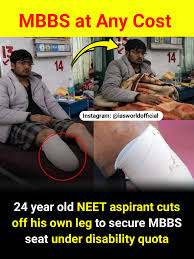
The huge number of registrations shows that students are willing to acquire education, skills, and knowledge, but the number of jobs available is limited. The cut-throat competition in these exams proves that the youth of the nation possess the required knowledge, passion to grow, and dedication to contribute positively to national development. Yet, they struggle due to limited opportunities.
When students invest years of effort into one exam, they become emotionally attached to that particular job. Securing that job becomes the sole purpose of their life. Despite tough competition, hope persists in every individual. The reputation of certain jobs and the placement guarantee offered by colleges make students ward off other alternatives.
This single-minded approach is the real problem. Many innocent students lack awareness about other equally valuable career paths. They have no one to guide them on how to deal with competitive exams and uncertainty. Parents often cannot provide support because they themselves were never exposed to such exams.
Thus, the problem is not only the lack of jobs, but also the lack of proper guidance. With the right direction, students can generate employment by adopting alternative paths. These directions should include emerging sectors that are shaping the future of the nation, such as research and development, artificial intelligence, renewable energy, biotechnology, and other technological innovations. Guiding students towards such areas will not only reduce pressure on traditional competitive exams but also help the country build a skilled workforce for future needs.
Students should be guided towards multiple ways of achieving success so that they can excel in life. Such exposure will ensure that talent and knowledge are not wasted in isolation or in narrow career tunnels. Schools currently teach academic subjects but fail to prepare students for real-life challenges. It is often assumed that students will learn these lessons through experience. However, repeated failure in competitive exams can lead to physical and mental exhaustion and cost students crucial years of their lives.
Therefore, schools should mandate self-help and guidance books that address topics such as handling competitive exams, mental health, planning alternative careers (Option B), and building resilience.
The crisis revealed by extreme competition is not merely about the scarcity of seats or jobs, but about the absence of structured guidance and diversified vision for young minds. When success is defined through a single narrow pathway, failure becomes devastating and talent remains underutilized. By exposing students to multiple career directions, especially emerging sectors, and equipping them with mental resilience and planning skills from an early stage, India can convert its demographic pressure into demographic strength. The goal of education must shift from producing exam-clearers to creating adaptable, skilled individuals who can build, innovate, and lead in a rapidly changing world.
Discover more from newscape.in
Subscribe to get the latest posts sent to your email.